Just a few things to chew on. Food trips in Metro Manila. Recipes, health tips, and kitchen experiments.
Showing posts with label rice. Show all posts
Sunday, July 27, 2014
Corn Rice
My aunt and I used to be really curious about what makes rice really yellow when it's served at Chinese restaurants, or, in my case, Indonesian festivals.
Egg yolks don't do that, at least not without sticking to every grain and changing the shape so that it looks lumpier.
Butter doesn't do that. Margarine doesn't do that without making it taste like margarine, which it didn't.
As it turns out, making a rice pilaf with turmeric spice or, if you can afford it then saffron, is what gives white rice a vivid yellow coloring.
Also, feeding genetically-modified golden rice to Chinese kids without telling their parents. But hey, it worked! Vitamin A for every body!
And now there's corn disguised as rice.
I've seen risoni pasta that's shaped like grains of rice, but corn is new.
Rico corn rice goes for about Php. 70 per kilogram, it does expand (just not as much as rice), and it cooks pretty speedy-quick. The instructions at the back of the pack say to wait for the water to boil first, then pour in the corn rice.
It doesn't taste very much like corn, which is too bad because I really do like the taste of corn even though it makes my stomach acids act up...and, I think corn rice kind of makes my stomach acids act up. Not as badly as actual corn, which gives me water brash, but just that I digest corn rice much faster and get hungry again after a couple of hours.
For that reason, I wouldn't change my staple to this, but it's an interesting ingredient to work with...
Here's me stuffing cabbages with corn rice...
The directions on the pack say that, unlike with real rice, it's better to wait until the water is boiling and then add the corn rice.
So, as the rice cooks below, the cabbage leaves get steamed up top...
I've been having a tactile food craving. I've been wanting to wrap something, like a tortilla or a crepe or something. Cabbage leaves would do, but I wondered how to get them to stay rolled. A tortilla, I could stick with some melted cheese or even cornstarch and water.
But as it turns out, cooked cabbage is very pliable. Once it's rolled into a wrap, it sticks to itself.
I thought the recommended amount of water on the pack, per cup of corn rice, actually left it quite dry. I overestimated the water the next time, and came out with a porridge.
So, I thought that I'd make it into champurrado. Not champorado, but champurrado substituting corn rice for corn meal, adding chocolate and cinnamon sugar.
Maybe I should specify...
- 1 cup corn rice
- 3 cups water
- 2 star anise...things...
- 2 Tbsp brown sugar
- 1 1/2 Tbsp cocoa powder
- dash of cinnamon
Although, I don't recommend this recipe that I made up because this was actually pretty intensely flavored. I steeped the star anises in the water, and kept them in there when the water boiled and I added the corn rice. When about halfway done, and the water had turned cloudy with what I supposed was corn starch, I plucked out both anise seeds. The corn rice retained the tangy numbing flavor.
...I still prefer the sticky rice version. While cornstarch is one effective thickener, corn rice doesn't seem to have any left after processing, so it was like ordinary rice dumped in hot chocolate.
I might have put too much anise, since the lift it gave to the dish was a little intense...
Also, the recipe I based this off mentioned star anise as a possible spice, but stuck with cinnamon. Good call, I think, since cinnamon in the chocolate did give it a very woodsy sort of groundedness. Both together...intense, is all I can say. Maybe if I'd doubled the amount of corn rice...because these are flavors that, though new to me in combination, I do think all worked really well together.
But I've thought up of other recipes to use corn rice in, which I'll write more on later.
Tuesday, July 8, 2014
Champorado, Bikorado, Bumbongorado
While the weather forecast lately says that no major storms have entered the Philippine Area of Responsibility, it has been drearily overcast and I've even gotten surprise attacks from squalls.
![]() |
| No, that would be too cool. |
Personally, my immune systems is so terrible that I get sick with the flu for a fortnight if you so much as whistle at me. You know what always helps stave it off, though? A hot, comforting bowl of sweet rice porridge. For some reason sweet rice is one of the English translations for glutinous rice that isn't necessarily sweet, but I mean glutinous rice that is also sweet in flavor.
Champorado
Yes, I'm talking about champorado, or it should be spelled tsamporado except that it's originally champurrado...at that last point, though, it becomes something else.
Chocolate, or at least the cacao beans that serve as the basis for chocolate--is a New World plant, which Spanish conquistadors brought from Meso-America to the Philippines.
In its country of origin, champurrado was a chocolate drink that was thickened with cornmeal meal and spices, sweetened to suit European tastes, and when this treat reached the Philippines we left off the chili peppers and replaced the corn with rice. We also grow our own chocolate, which has its own distinct "lift" in its flavor.
Health note: Despite its name, glutinous rice that champorado is made with does not actually contain gluten, and is therefore safe for consumption for those afflicted with Celiac's.
Nowadays, we can get pre-packaged quick cook champorado. I wanted to make my own, and was surprised to find that champorado actually already is very quick to cook. Step one--
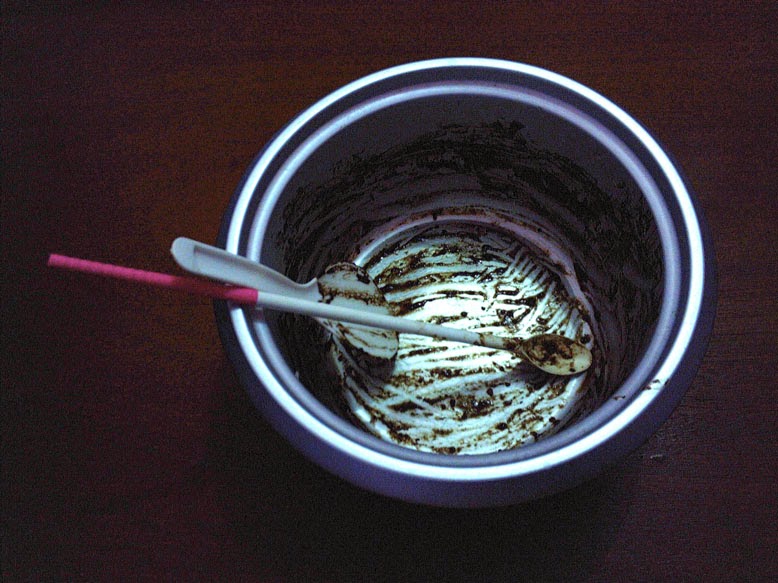
Uh... oh, sorry, I was supposed to show how to cook it but I accidentally ate the whole thing before I could do so.
Ingredients:
- 2 cups of glutinous rice
- 8 cups of water, give or take a cup depending on how thick or runny you want it
- 1/2 cup cocoa powder
- 1 cup sugar (if cocoa powder is unsweetened)
Since I couldn't find tablea chocolates at the grocery store, I just used ordinary cocoa powder and it just tasted like it was missing something--but obviously I just kept on eating, because it was still chocolate and chocolate is still good.
I didn't soak the glutinous rice overnight or anything, I just washed it and left it to boil in the rice cooker with the water. Instead of just leaving it there, though, I'd give it a good stirring once in a while, to prevent the bottom from burning, and also to taste-test whether or not the grains are cooked all the way through.
The rice cooker will detect if the rice is done because when the rice has absorbed all the water, or the water has evaporated into steam, then the temperature in the rice cooker pot will rise suddenly and that will be the rice cooker's cue to click from "cook" mode to "keep warm" mode.
However, this is a rice porridge, so I would advise against depending on that flip-switch cue because if all the water has been absorbed or evaporated then it's no longer a porridge. When the rice is soft to the tooth and of the consistency you want when you stir it (maybe slightly more runny, because it will congeal as it cools) then it's ready.
Then again, when it was done I just added the cocoa powder and sugar into the rice cooker pot, which the manual sort of advises against...
| YOU DO NOT COMMAND ME!!!!! |
I used a mix of brown sugar and pure molasses.
Health note: Pure molasses, also known as blackstrap molasses, is a syrup made from sugar cane or sugar beets that is far less processed than sugar and therefore retains the nutrients of the plants. It is high in minerals, iron, calcium, magnesium, and potassium... and it also tastes terrible.
Mixed with brown sugar, though, it tastes a little bit to me like muscovado sugar, which is unrefined sugar that actually tastes pretty good.
A bit of evaporated milk and/or salty dried fish brings out the best of chocolate rice champorado, although I'd like to try that champurrado out some day.
Bikorado
Today, I tried out another kitchen experiment. Biko is a sticky rice pudding made with a coconut milk and sugar syrup. I figured I'd take what I learned from making champorado, and transfer those flavors over to a porridge version.
Ingredients:
- a handful of ginger, sliced
- a large pinch of calamansi (or lime) rind*
- 5 cups of water
- 1 cup glutinous rice
- 1 cup brown sugar
- a dash of iodized table salt
- pure molasses
- coconut milk to taste
* not available to me at the time of this kitchen experiment
While the pudding biko usually steams the rice to then cook in the coconut milk to absorb the flavor, I figured that this porridge biko could take the flavor in easily enough if added later. Besides, I didn't want burnt coconut at the bottom of the cooker pot.
This being an experiment, I only used one cup of glutinous rice to four cups of water, with an extra thrown in because I'd be making ginger tea first. I basically boiled half a root of ginger (sliced) in the pot until I could smell ginger in the steam. The steeping of flavor can go on for a long while because ginger doesn't have tannin to release if it's over-boiled to turn the water too bitter, but some people don't like ginger to be too strong. When staving off the cold, though, I use a lot and get as much ginger flavor out of it as I can.
Remove the ginger root slices from the water when the water is adequately flavored. If I had grated calamansi rind, I'd add that in between removing the ginger and putting in the rice.
After washing the rice, I just throw it into the pot with the ginger tea to boil until soft.
Once the rice is soft, mix in the salt, sugar, a couple spoonfuls of molasses, and a swirly stream of coconut milk.
I consider this experiment a success.
Bumbongorado
Lately, I've been seeing Jordan Farms' Tapol de Oro brand of glutinous purple rice at the grocery store, and have been very tempted to run a similar experiment.
I'd like to make a porridge version of puto bumbong, which is sausage-shaped violet sticky rice, that my research (by "research" I mean "Google" and "Wikipedia") has told me used to be made out of flour ground out of purple rice. Nowadays, it's white glutinous rice flour mixed with purple yam powder. It's usually served slathered in butter and dipped in muscovado sugar and/or grated coconut (also burnt coconut drippings, which in Luzon is called latik.)
Of course, if I make it into a porridge, then I can't call it puto or bumbong.
But... just brainstorming here... if I managed to find a pack of heirloom purple or black glutinous rice that wasn't a full 800 kilgrams, then I'd cook it into a porridge, add some purple potato powder, dollop butter into the bowl I was going to add it in, and then top it with butter because the puto bumbong that I know of tends to be served positively slathered in butter... and then add sugarcane sweet and/or grated coconut.
White puto porridge would have white sugar (1/2 cup of that to one cup rice and 4 cups water, I'm guessing), coconut milk (one cup), butter (tablespoon) and an egg, maybe even some quickmelt cheese to top it at the end. The egg and butter make mixing it in evenly rather tricky, since this wouldn't be a flour gruel where the flour would emulsify it. I'd go with the trick of mixing the egg and butter in a bowl, then pouring some cooked porridge into it from the main pot, then pouring it back into the main pot to mix with the rest of the porridge. For once, I might not just change the form of the food for the sake of it, and just enjoy a solid puto!
Subscribe to:
Posts (Atom)